Ancestors from the Russian Partition: Which Records Survive and Where to Find Them
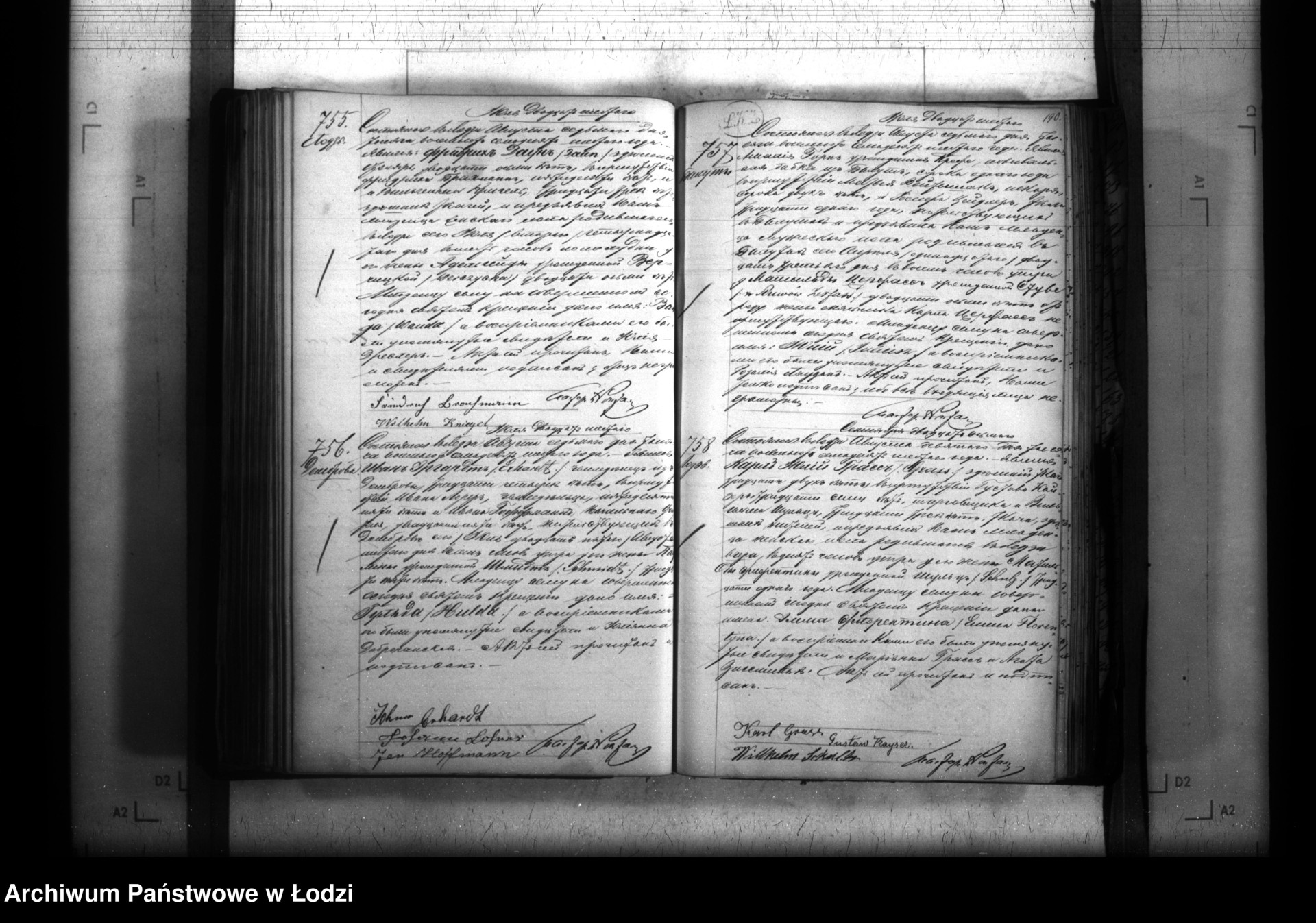
Most people tracing ancestors from the Russian partition hit the same wall at the same point. They find the parish, they find the scans, they open the book, and the writing is in Cyrillic. Not the flowing Polish of the earlier volumes. Russian, in a nineteenth-century hand, describing a Catholic baptism in a Polish village.
That switch happened in April 1868, and it shapes more of the research in this zone than anything else does. It decides what you can read, whether you can read it at all, and what a translator has to do before a document is any use for a citizenship file.
The rest of the picture is better than people expect. Russian administration in Poland was heavy, intrusive and thorough, and thoroughness leaves paper. Below: what survives, where it sits, and which sources people skip once the parish books stop cooperating.
What the Russian Partition Actually Was
Russia took the largest share of Poland in the partitions, and that share was never one thing. Two territories with two completely different record systems get lumped together under the same phrase, and confusing them wastes months.
The first is Congress Poland, created at the Congress of Vienna in 1815 as the Kingdom of Poland, with Warsaw as its capital and a Russian emperor as its king. It had its own constitution, its own army and its own legal code. It covered what is now Mazovia, Łódź, Lublin, Podlasie, the Świętokrzyskie region, the Kalisz area, and a strip running up into present-day southwestern Lithuania. If your family came from Warsaw, Łódź, Lublin, Radom, Płock, Kielce, Siedlce or the villages around them, this is your territory.
The second is everything east of that: the lands taken in the partitions and absorbed straight into the Russian Empire as ordinary gubernias. Vilnius, Grodno, Minsk, Volhynia, Podolia. Poles lived there in large numbers and often called it the Kresy, the borderlands. Administratively it was simply Russia, and it never had the Napoleonic record system that Congress Poland kept.
The distinction matters because the two produced different documents, and those documents are now in different countries. Congress Poland records are largely in Polish state archives. Kresy records are in Vilnius, Minsk, Kyiv and the regional Ukrainian archives. Everything below applies mainly to Congress Poland, with the eastern lands flagged where they differ.
Two political events also left marks you will see in the paperwork. The failed uprising of 1830 stripped the kingdom of its constitution and army. The failed uprising of 1863 removed what was left and brought the Russification programme that produced the 1868 language decree, the renaming of the territory as Vistula Land, and the 1867 reorganization into ten gubernias with a new lower unit, the gmina. The same defeat produced the 1864 land reform, which turns out to be one of the best genealogical sources in the whole partition.
The Language Timeline
Keep this table open in another tab. Everything about the difficulty of your search follows from where your years fall.
| Period | Language of the record | What was happening |
|---|---|---|
| Before 1808 | Latin, occasionally Polish | Church registers only. Short entries, often a single line. |
| 1808 to 1825 | Polish | Napoleonic civil registration begins 1 May 1808 in the Duchy of Warsaw. Long narrative paragraphs. The Catholic parish priest registers everyone, whatever their religion. |
| 1826 to March 1868 | Polish | Each denomination keeps its own register. The format is shortened but still narrative. |
| April 1868 to 1918 | Russian, in Cyrillic | The decree applies to church and civil registers alike. Names are transliterated into Russian. |
| After 1918 | Polish | Independence restores Polish. |
Two consequences follow, and both are practical.
If your ancestors emigrated in the great wave between 1880 and 1914, which most did, then their birth, marriage and death records are in Russian. Not some of them. All of them. The Polish-language records you can half read by guessing at cognates belong to their parents and grandparents.
And because the 1868 rule covered church books as well as civil ones, there is no Polish-language backup copy for those years. The parish priest wrote in Russian because he was required to. A Catholic baptism in a Polish village, recorded by a Polish priest, in Russian.
Who Kept the Books
From 1808 to 1825 the Roman Catholic parish priest was the civil registrar for the whole population. A Jewish birth in that period is recorded in the Catholic parish register, which surprises people who go looking in the wrong place and conclude nothing survived.
From 1826 onward each denomination kept its own books: Roman Catholic, Greek Catholic in some eastern areas, Lutheran and other Protestant congregations, Orthodox, and Jewish records kept by the local registry district. In Congress Poland the register was both the church record and the civil record at the same time, which is why the two are almost indistinguishable in this zone.
One structural feature here matters more than most people realize. Registers were kept in duplicate. The parish held the original and sent a copy to the district court or the relevant authority, and those copies went on to the state archives. When a parish burned, or a front line went through it, or a priest lost a volume, the second copy is often still there. Two chances at the same record is not something researchers in every partition get.
Do the Homework at Home First
Before you write to any archive, work through what you already have. This step is dull and it decides whether the rest is possible.
Search the house for old passports, naturalization papers, certificates, prayer books with names inside the cover. Then talk to the oldest people in the family, who reliably know more than they think and will not be around forever.
Then write down the names and dates. But the piece of information that beats all of it combined is the name of the village. Not the province, not the nearest city. The village. If you are stuck at this stage, pinning down a specific town and parish is the thing to solve before anything else.
Russian-partition research adds its own twist. Place names on American documents were often written down by a clerk who heard them once, and some of those names had already passed through Russian transliteration before that. A village can travel from Polish into Cyrillic, back into Latin letters by an official who had never seen it written, and end up somewhere no gazetteer will match.
From Village to Parish
Records were kept by parish, and most villages did not have one. You need to know which parish covered your village in the years you care about.
The standard tool is the Geographical Dictionary of the Kingdom of Poland and Other Slavic Countries, published between 1880 and 1902 and free online at dir.icm.edu.pl. Enter the village name and you get a period entry with its administrative position, its population and its parish. It was compiled while the Russian partition was in force, so its administrative descriptions are contemporary rather than reconstructed. That makes it more reliable here than in most applications.
Where the Records Physically Sit
State archives hold the bulk of it: the duplicate register copies, the civil administration files, census material, land records, court and notarial papers. The Central Archives of Historical Records (AGAD or Archiwum Główne Akt Dawnych) in Warsaw holds significant register collections, and each regional state archive holds the material for its own area.
Church archives start at the parish, which may still hold the original registers, and continue up to the diocesan archive. Parish access varies enormously by parish and by priest. Some are helpful, some are not, and none of them are obliged to be.
There is also a cutoff that catches people out. Recent records sit with the local civil registry office (the USC) rather than the archive, under a different access regime with different rules about who may request what. The thresholds are a hundred years for births and eighty for marriages and deaths, and there is a wrinkle: a volume does not transfer until every entry inside it has cleared the limit, so a birth book running from 1910 to 1925 only became eligible in 2026. If your target year falls anywhere near that window, check which building holds it before you write to anyone.
| What you are looking for | Start here |
|---|---|
| Birth, marriage, death registers, 1808 to about 1925 | State archive for the region, then the parish or diocesan archive |
| Births under 100 years old, marriages and deaths under 80 (read more here) | Local civil registry office (USC), not the archive |
| Jewish registry district records | State archive for the region |
| Books of permanent residents, 1864 land tables | State archive |
| Notarial files, wills, contracts | State archive holding that notary’s collection |
| Records from the Kresy | Vilnius, Minsk, Kyiv or the regional Ukrainian archives |
What the Records Actually Tell You
Napoleonic-format entries are wordy, and the wordiness works in your favour. A birth entry from this system runs to a full paragraph and typically names the father with his age, occupation and place of residence, the mother with her age and often her maiden name, two witnesses with their ages and occupations, the godparents, and the date and hour of the birth. Set that next to a one-line Latin baptism from the 1780s and the difference is enormous.
Marriage entries are better still. They give both spouses with ages, residences and marital status, the parents of both, and where a previous spouse had died, that fact is stated. A single marriage record can hand you two complete parental couples.
Death entries carry the date, the age, usually the occupation, frequently the parents, and the surviving spouse.
After 1868 the same information is there in Russian. The structure of the entry did not change, and that is useful: once you know where the father’s name sits in the Polish version of the form, you know where it sits in the Russian one. The alphabet is the obstacle, not the layout.
The Cyrillic Problem
Reading these records is a separate skill from finding them, and in this partition it is the skill that stops most people.
It is not only the alphabet. It is nineteenth-century Russian cursive, which does not look much like the printed Cyrillic you can learn from an app, and several letters are near identical in a fast hand. Then there is transliteration. A man named Wojciech Szczepański becomes Войцех Щепаньский on the page, and turning that back into Polish spelling means knowing which conventions the clerk was using. Surnames get mangled. Given names often get translated into their Russian equivalents rather than transliterated, so Wojciech may appear as Адальберт, from the Latin Adalbertus, and nobody meeting that for the first time makes the connection unaided.
Learning to read your own records is a separate problem from finding them, and it takes its own time.
There is a further step if the document is going anywhere official. A Russian-language birth record from 1890 that supports a Polish citizenship claim cannot be submitted as it stands. It needs a sworn translation by a translator on the Polish Ministry of Justice list, and this catches applicants out repeatedly, because they assume sworn translation applies only to their American paperwork. It applies in both directions. The foreign documents need translating into Polish, and so do the partition-era Polish documents that happen to be written in Russian. If your file is heading toward a citizenship application, sworn translation of the archival documents is part of the job, and budgeting for it early beats discovering it at the end.
When the Parish Books Run Out
The registers are the backbone, but Russian administration generated a great deal of other paper about ordinary people, and some of it is better than the registers.
Marriage Supplements (Alegata)
Before a marriage could be performed, the couple had to produce documents: birth certificates, death certificates for a previous spouse, permission from a military authority for a man of conscription age. Those supporting documents were bundled and filed, and many of the bundles survive as a separate collection.
This is the most underused source in the partition. An alegata file can contain a copy of a birth record from a parish whose own registers were destroyed, sometimes from a different parish in a different region, because the bride came from somewhere else. When the register is gone, the marriage supplements may still hold a transcript of exactly what was in it.
Books of Permanent Residents (Księgi Ludności Stałej)
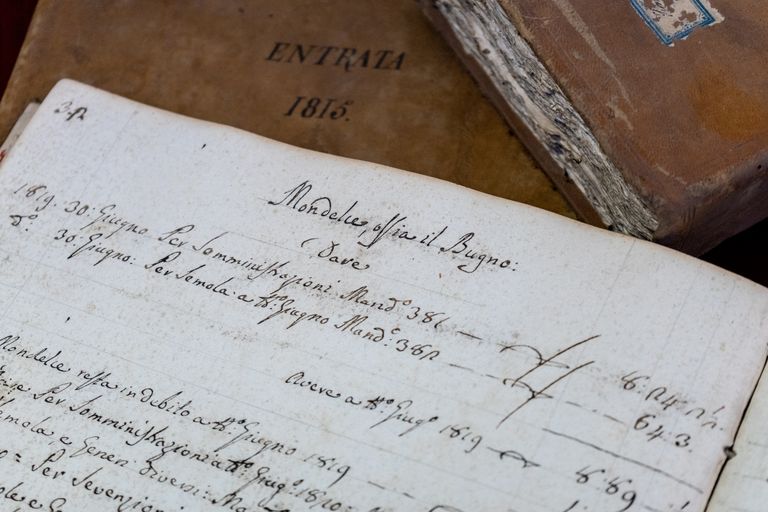
Kept from the 1860s onward, these register the permanent population household by household, and they are not a snapshot. They were maintained and amended over decades, so a single page can show a family across thirty years: births added, deaths struck through, marriages noted, departures recorded with a destination.
For each person you typically get date and place of birth, parents’ names, marital status and religion. Find your family in one of these and you often get several generations in one document, along with the birthplaces you need in order to go looking for the actual records. Coverage is patchy, and they are held partly in state archives and partly by local offices, but when they survive they are among the most useful things in the zone.
The 1864 Land Tables
The tsar’s 1864 decree on peasant enfranchisement handed land to the peasants who worked it, partly to punish the Polish nobility for the uprising. To do that, the administration had to record who was getting what, and it did so village by village in documents called tabele likwidacyjne and tabele nadawcze.
If your ancestors were peasants, and statistically they were, these tables name the head of each household with the exact plot assigned to him. For a family that appears nowhere except in parish registers, this is a document that puts them on a specific piece of ground in a specific year. Collections for the Lublin and Siedlce gubernias, among others, sit in Polish state archives and are partly catalogued online.
Notarial Records
Notaries kept files and most of those files survived. Sale contracts, prenuptial agreements, wills, inventories of estates. A prenuptial contract mentioned in a marriage record exists somewhere, and it can hand you property details and family relationships that no register carries.
The difficulty is access. Notarial collections are arranged by notary and by year, never by client. You have to establish which notary served your ancestor’s district in the relevant period, then read through his register. A digitized file is not a searchable one.
Conscription and Military Records
Russian conscription reached deep into the male population, and lists of eligible men were compiled locally. If a male ancestor vanishes from the parish in his early twenties, conscription is a likely explanation, and the surviving lists can tell you when he was called and where he went.
Court and Police Files
Russian administration in Poland was a security operation as much as a civil one, particularly after 1863. Police registers, passport applications for people leaving, files on political suspects. If a family story involves someone in trouble with the authorities, or a sudden departure nobody ever explained, this is where to look.
Where to Search Online
A large share of this can be done from a laptop. The standard working method is databases and scans first, then written queries to whichever archive holds what is not online. Visiting in person unlocks specific files occasionally, but it is not where a project starts and rarely where it ends.
One caution before the list. Scanned and findable are not the same thing, and the gap between them is where a lot of searches quietly fail. Millions of pages from this partition have been photographed and never indexed by name. A database returning nothing frequently means nobody has typed the names in yet.
| Resource | What it covers | Where it stops |
|---|---|---|
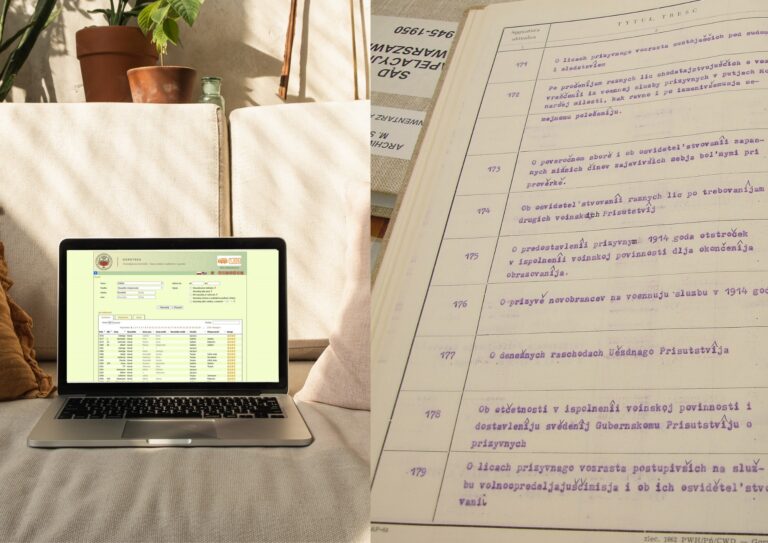
| Geneteka | The volunteer-built index of the Polish Genealogical Society. Over 47 million indexed entries from more than 4,500 parishes, searchable by surname, with births, marriages and deaths separated. The first place to look for a Congress Poland family. | Coverage is uneven by design, since it depends on which parishes volunteers have finished. A blank result says nothing about whether the record exists. Marriage indexes are generally better covered than deaths. |
| Metryki / Skanoteka | Scans of registers, organized by archive and parish, often the images behind Geneteka index entries. | You browse by volume and page, not by name. You need the parish and year before it helps. |
| Szukaj w Archiwach | The Polish state archives platform. Register copies, land tables, notarial files, books of residents. Enter a place name to see which collections exist and which are digitized. | It confirms a collection exists, not that your year survived inside it. Most scans are unindexed, so you read page by page. |
| FamilySearch | Large numbers of free scans, including microfilm shot decades ago from registers that have since been damaged. | Only a minority of the Polish material is indexed by name. Much is browse-only, and some collections are viewable only at an affiliate library. |
| JRI-Poland | The main index of Jewish vital records from Polish territories, including the Russian partition registry districts. | Indexed by town, and coverage varies sharply between towns. |
| Geographical Dictionary | Village to parish and administrative district, as they stood under Russian rule. | Nineteenth-century Polish, and it assumes you already have the correct spelling. A phonetic name off an American document will not match. |
| Lithuanian, Belarusian and Ukrainian state archives | The Kresy. Vilnius (LVIA), Minsk (NIAB) and the regional Ukrainian archives hold the records for territory absorbed directly into the Russian Empire. | Not search-and-download services. Access runs through correspondence or on-site consultation, in the local language, on the archive’s timetable. |
Where People Usually Get Stuck
An amateur with patience can get a long way in this partition. Identifying the village, working out the parish, checking the catalogue to see what survives, running names through Geneteka: all of that is doable from home and rewarding to do yourself. Reconstructing a line out of the records themselves is a different order of work.
The sticking points are fairly predictable. The village name off the American document is a phonetic guess that matches nothing real. The parish is identified but the years you need are in Russian cursive you cannot read. Geneteka has not reached that parish, the scans are unindexed, and somebody has to read three hundred pages to find one entry. The register is destroyed, and getting past that means knowing that alegata exist and how to find them. Or the family turns out to be from Vilnius gubernia rather than Congress Poland, and the whole approach changes.
Get one distinction straight before you hire anyone, because it causes most of the disappointment in this field. Ordering a document you have already located is a fixed job: you know the parish, the year, the volume, and the only variable is how long the archive takes. Working out whether a record exists at all is open-ended, and nobody can promise you an outcome, only hours spent looking. Those are different services at different prices, and you should hear that said out loud before you pay rather than afterwards.
If you have hit one of those points, professional research in the Polish archives is a reasonable next step rather than an admission of defeat. If the records are found but unreadable, sworn and genealogical translation is the narrower service. If you already know exactly which document you need and where it sits, document retrieval is narrower and cheaper again. And if you would rather see who would actually be doing the work before writing to anyone, that is a fair thing to check first.
Frequently Asked Questions
Why are my Polish ancestors’ records in Russian?
Because of a decree that took effect in April 1868, requiring all vital records in Congress Poland to be kept in Russian. It applied to church registers as well as civil ones, so a Catholic baptism recorded by a Polish priest in a Polish village was written in Russian. The rule stayed in force until Poland regained independence in 1918.
Which parts of Poland were in the Russian partition?
Congress Poland covered present-day Mazovia, Łódź, Lublin, Podlasie, the Świętokrzyskie region and the Kalisz area, with Warsaw as its capital. Further east, territory that is now Lithuania, Belarus and western Ukraine was absorbed directly into the Russian Empire and had a different record system.
How far back do the records go?
Napoleonic civil registration starts on 1 May 1808, and that is the point where records become detailed. Before it you are looking at Latin church registers, which in some parishes reach into the seventeenth century and in others were lost entirely. Survival varies parish by parish, so the honest answer for any specific family is that you check.
Do I need to read Russian to do this myself?
For the years from 1868 to 1918, yes, or you need someone who can. The entries follow a fixed structure, so it is learnable, but nineteenth-century Russian cursive is harder than it looks and names were transliterated in ways that are not intuitive. Most people who get through the Polish-language years without help stop at the Russian ones.
My ancestors were peasants. Will there be anything about them?
Usually more than you expect. Beyond the registers, the 1864 land tables name peasant householders with their assigned plots, the books of permanent residents track whole households across decades, and conscription lists cover the male population. Russian administration did not exempt the poor from record-keeping.
Can I do this without travelling to Poland?
For most cases, yes. Geneteka, Szukaj w Archiwach, Metryki and FamilySearch cover a lot, and material that is not online can usually be requested in writing. Records from Lithuania, Belarus and Ukraine are harder, and that correspondence is slower.
I only know my family came from “Russian Poland”. Is that enough to start?
Not yet, but it points you at the right next step. North American sources are where the village name usually hides: naturalization papers, passenger manifests, draft cards, records from the American parish, death certificates. One of them names a specific place, and that place is what makes archive research possible.
The Takeaway
The Russian partition has a reputation for being the hard one, and half of that reputation is earned. The Cyrillic years are a real barrier and they cover exactly the period when most families left.
The other half is not. Napoleonic-format records are richer than anything the other partitions produced. Registers were kept in duplicate, so a lost volume is not necessarily a lost record. And the administration left behind land tables, residence books and marriage supplements that can rebuild a family when the registers cannot.
Order of operations decides most of it. Work out the village, then the parish, then whether you are in Congress Poland or the eastern gubernias, then check what survives before you go hunting for what is in it.
And if the answer turns out to be three hundred unindexed pages in a hand you cannot read, that is the point where handing it to someone who works in these archives stops being a luxury and starts being the only way the line moves.